Mourning is not a luxury. From the event to the trial
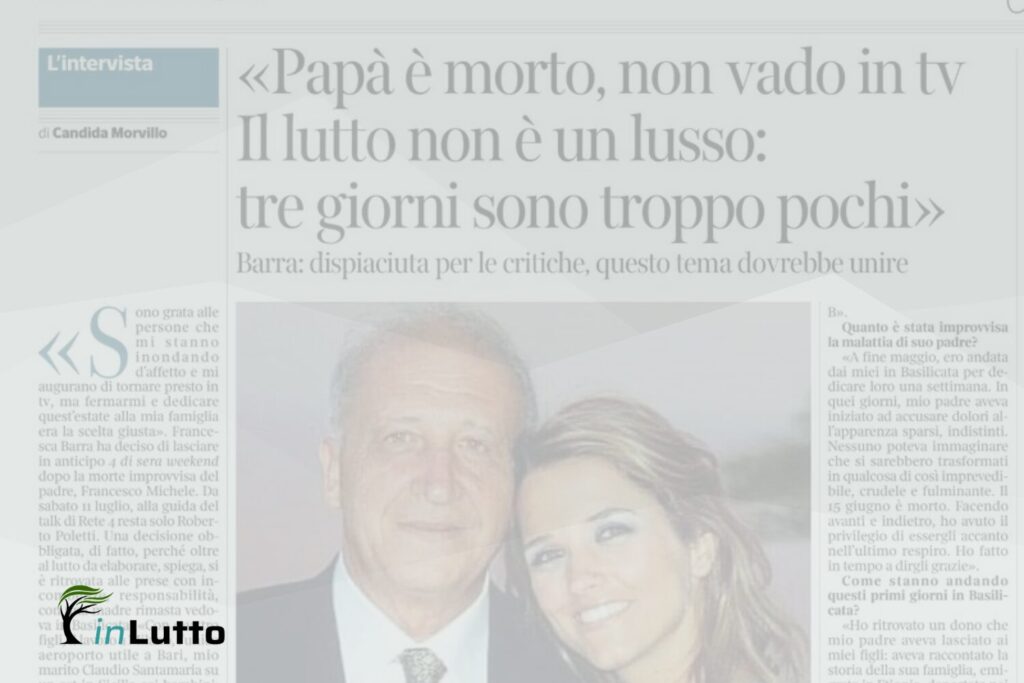
In recent days, Francesca Barra’s words, following the sudden death of her father, have sparked a debate that goes far beyond her personal circumstances. As is always the case when grief enters the public sphere, reactions have been varied: expressions of sympathy and empathy, but also criticism, judgements and comments on whether or not one should take time out, on work, on responsibilities, and on the ‘duty’ to carry on.
Yet at the heart of this discussion lies a statement that deserves to be taken seriously: mourning is not a luxury.
This is not a rhetorical statement. It touches on a sensitive aspect of our culture: grief is often recognised as an event, but far less so as a process. Death occurs, the funeral is arranged, a few days’ leave are granted, and immediate tasks are dealt with. Afterwards, however, the world seems to expect the person to quickly return to their place: at work, in family roles, with deadlines, and daily responsibilities. As if the social timeframe for mourning were much shorter than the internal time needed to even begin to understand what has happened.
This discrepancy between external time and internal time is one of the most difficult aspects of grief. From the outside, the loss may appear to be a discrete event: there was a ‘before’, there is an ‘after’, and in between a precise moment when death occurred. For those left behind, however, the loss does not end at that moment. Indeed, it often only really begins afterwards. It begins when the phone stops ringing, when a room remains empty, when news can no longer be shared, when an anniversary takes on a new meaning, when the body continues to search for a presence it can no longer find.

In the story recounted by Francesca Barra, at least three important levels emerge.
The first is the personal level.
A loss, especially when it is sudden, does not merely cause sadness. It can trigger shock, disbelief, daze, a sense of unreality, anger, a need for protection, confusion and emptiness. It can make it difficult to concentrate, remember, sleep or hold a normal conversation. It can make a person feel ‘present’ physically, yet emotionally distant from themselves and others. This does not mean they are weak or incapable. It means that their mind, body and emotional system are trying to cope with an enormous shock.
Many people who are grieving describe it exactly like this: the world carries on turning, whilst inside, something is at a standstill, suspended, in disarray. Some people need to talk, whilst others cannot bring themselves to say a word. Some want to be with others, whilst others feel the need to withdraw. Some people throw themselves back into their daily routines straight away, almost as if to numb the pain, whilst others cannot even imagine resuming their usual activities. None of these responses, taken on its own, tells the whole story about a person. They are simply different ways in which grief seeks to make itself felt.
The second aspect concerns work.
And this is perhaps the most uncomfortable, because it forces us to ask a practical question: what are we asking of a person when we ask them to return to work straight away after a significant loss?
This is not to say that work is always an obstacle. Sometimes it can also provide structure. It can give rhythm to the days, offer a framework, and prevent us from remaining completely immersed in grief. For some people, returning at least partially to a routine can be a source of support. But the problem arises when returning to work is confused with a return to normality.
Returning to work does not mean being back to how things were before. Opening a computer, attending a meeting, replying to an email or speaking in front of an audience does not necessarily mean being fully present, clear-headed or whole. After a loss, especially in the first few days and weeks, a person may be present whilst at the same time feeling deeply vulnerable. They may cope at times, then break down. They may manage to deal with some things but not everything. They may need a gradual approach, breaks, protection, and some leeway for imperfection.
The point, then, is not merely how many days’ leave are provided. Of course, the issue of days is important, because three days may be enough for some practical emergencies, but they are rarely sufficient for a significant loss. However, the discussion cannot stop at mere numbers. The real issue is the culture of returning to work: how does an organisation welcome someone back after a bereavement? With what expectations? With what leeway? With what ability to distinguish between physical presence and genuine emotional, cognitive and relational availability?
To say that bereavement is not a luxury also means recognising that not everyone can afford to truly take time off. There are those with precarious employment contracts, those who fear the consequences, those who are self-employed, those with immediate financial responsibilities, and those without a supportive family network. In these cases, bereavement not only causes pain: it also becomes something to be suppressed, hidden away and dealt with in silence. And this suppression can increase loneliness.
The third level is cultural and social.
In our society, grief is still often treated as a private matter. Something that concerns the intimate, family and domestic sphere. Something to be spoken of sparingly, and preferably not for too long. But grief does not remain confined to the home. It permeates workplaces, schools, relationships, communities and public spaces. It intrudes on the rhythm of productivity and disrupts it, because it reminds us that life is not always compatible with immediate efficiency.
Perhaps this is precisely what disturbs us: grief interrupts. It disrupts the illusion that everything can be planned, measured, managed and optimised. It reminds us that there are times when a person cannot simply ‘perform’ as before. And a culture that fails to make room for this disruption risks asking people not only to grieve, but to grieve without causing a disturbance.
The right to grieve, then, should not be understood merely as the right to take a few days off. It should also be the right not to have to slip back immediately into the mask of normality. The right to be regarded as people, not just functions. The right to a gradual process. The right not to have to prove straight away that one is strong, efficient, clear-headed, helpful, ‘fine’.
This does not mean turning workplaces into therapeutic environments. It does not mean asking colleagues or managers to become psychologists. It means, quite simply, fostering an organisational culture capable of recognising that grief exists, that it unfolds at different paces, that it can affect concentration, energy, memory and relationships, and that supporting someone through this process is not an exceptional favour, but a civilised gesture.
From the event to the process: perhaps this is where we should shift our focus.
Death is an event. Grief is what happens afterwards, over time. It is the way in which a person tries to reorganise their life around an absence. It is the silent work through which the outside world – which seems to have remained the same – must be navigated by a person who, inside, is no longer quite the same.
This is why mourning is not a luxury. It is not a concession. It is not a private weakness to be quickly swept under the carpet. It is one of the most profoundly human experiences we can go through.
And perhaps a more mature society can also be recognised by this: by the way it knows how to stand by those who, for a period of their lives, cannot simply pick up where they left off!